Zone Sonography Technology Conventional ultrasound systems acquire data line-by-line with each line being acquired at the speed of sound propagation in the body. As a result, the entire process of acquiring image data and beam formation is limited by the speed of sound. Zone Sonography,...
read full descriptionPlease either Login or Register for an account
(From Zonare)
Conventional ultrasound systems acquire data line-by-line with each line being acquired at the speed of sound propagation in the body. As a result, the entire process of acquiring image data and beam formation is limited by the speed of sound.
Zone Sonography, developed by ZONARE Medical Systems, isn’t simply an improvement in current ultrasound technology. It is a fundamentally new approach to data acquisition and image formation. Zone Sonography acquires larger quantities of data very quickly in relatively few “zones” and processes the data at the speed of light—in other words, the speed of the processor. So the throughput is substantially faster and there is more time for a variety of advanced processing options while still delivering extremely high image quality. Since it is implemented almost entirely in software, Zone Sonography systems are smaller, lighter and less expensive than traditional systems offering equivalent image quality—yet deliver performance and flexibility that far exceeds any other ultrasound technology.
Performance of Zone Sonography systems is limited only by the power of the processor. According to Moore’s Law, processing power will continue to double approximately every eighteen months for the foreseeable future, offering the promise of substantially improved speed and capability. Since conventional systems are implemented primarily through hardware, they do not significantly benefit from increased processing power.
In addition, after conventional ultrasound systems form each line by summing together the contributions of all the channels in the transducer, the original channel data are discarded. The z.one system, on the other hand, aggregates the original channel data and stores this information in Channel Domain™ Memory. All of the original raw echo information is then utilized in Channel Domain Processing™ to form the image.
Channel Domain Memory and Processing are ZONARE’s proprietary methods of acquiring and managing data. It is the only ultrasound system that is implemented primarily in software. As a result, data equivalent to individual “lines” are stored permanently in a separate cine memory, substantially increasing post-processing options. This approach provides greater flexibility by employing a more complete data set in processing the echo data, significantly increasing the accuracy of the image. The clinician benefits from increased speed, lower costs and more processing options that are not possible with conventional systems which offer premium image quality. Channel Domain Data also allows the user unprecedented flexibility in optimizing a frozen image, offering a significant benefit in mobile examinations.
New clinical applications and enhanced system capability can be made available to the clinician quickly and inexpensively through software upgrades. Long development cycles and the high cost of system upgrades no longer need to be an impediment to the improvement of clinical capability. Upgrades for the z.one platform can be provided quickly and easily through a variety of common data distribution media. This is extremely economical, prolongs the useful life of the system, and keeps the clinician at the leading edge of ultrasound technology.
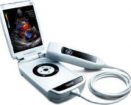
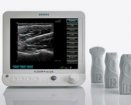
Zone Sonography makes it possible to produce the first Convertible Ultrasound™ system, a compact system with all the quality and performance of substantially larger and more expensive systems while still delivering significantly higher performance than previous portable and compact systems. The z.one platform consists of a full featured cart based system and a compact system, the convertible scan engine, capable of high-resolution, full-exam operation. Essentially, the z.one platform is two systems in one.
The cart itself is designed from the ground up to accommodate the needs of the operator. Cart height is easily adjustable. The highly advanced LCD display works extremely well in ambient light conditions, is easy to position, and collapses for convenient transport. The backlit alphanumeric keyboard is easy on the eyes as well as the hands. Probes and cables have been ergonomically designed to be as user-friendly as possible. They are light, easy to use, and fit naturally in the hand. Unlike other compact systems, the cart has a full user interface that works like a conventional ultrasound system
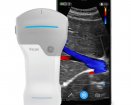
The convertible scan engine, the “brain” of the system, is contained in a self-enclosed, compact unit that can be removed from the cart and transported to the patient quickly and easily. The compact unit weighs less than six pounds and can be used for hand-supported, one-thumb operation.
Whether using the z.one system in a cart configuration or just the standalone compact unit, it is never necessary to compromise image quality. Full functionality is available in both configurations—including advanced imaging and multiple simultaneous modes without sacrificing frame rate.
The z.one platform is ideal for both traditional and non-traditional radiology setting such as the emergency room, where access to the patient may be limited and time at a premium, and to situations where the patient is difficult to access, such as the ICU. Its unprecedented adaptability and flexibility combined with premium quality imaging enable the system to adapt to the workflow on demand, substantially improving productivity and responsiveness.
The combination of portability and image quality also makes it possible to perform more examinations per day by enabling the clinician to transport the scanner quickly and easily and reducing the necessity for repeat scanning due to questionable image quality. Additionally, focal zones are no longer an issue, saving a substantial amount of time.
The z.one platform provides the same image quality and functionality as the traditional 400-pound ultrasound cart system. Yet it is substantially smaller, lighter, more maneuverable, and nimbler than any system of equivalent image quality. The operator is therefore relieved of the sheer physical burden of pushing unwieldy equipment, especially when using the system in its compact form. The z.one platform is also easier to maneuver into an ergonomically correct position than a conventional system.
The software-based architecture of the z.one platform and reduction of development costs substantially improves the price/performance ratio. It offers a lower purchase price and lower maintenance cost than conventional systems with comparable image quality due to the elimination of costly proprietary hardware and the inherent simplicity of the physical aspects of the system. As a result, the z.one platform provides a substantially lower lifetime cost of ownership including reduced service costs due to the compact nature of the technology. The potential for performing a greater number of exams each day, the simplicity and economy of software updates and upgrades, and the resulting long-term viability of the platform, also contribute to a compelling story of superior economics.
Zone Sonography technology and Convertible Ultrasound from ZONARE Medical Systems make it possible to produce a premium compact ultrasound system with all the quality and performance of substantially larger and more expensive systems, and with significantly higher performance than conventional portable and compact systems. Initially, the system will provide clinical solutions for the general imaging, vascular, and OB/GYN markets with subsequent upgrades for other applications such as cardiology. Commercial shipment of the z.one ultrasound platform started in February 2005.
I agree entirely with Dr Haslam. This is an excellent multipurpose versatile machine that goes beyond the performance of other "laptop ultrasound" machines. I summarize; Features The scan engine is lighter than my current GE LogiqBook, and is more robust. I agree, it is a bit stiff attaching it onto the SmartCart. The screen is small but adequate, similar to earlier Sonosite models, when used on its own. But this machine is best when attached, as the screen is so much bigger and better. Technology The fact that focussing is not needed and opimisation really is instant make this an amazingly powerful little beast. The signal output is the newer digital format, but we have used an adaptor provided by Zonare to hitch the image to our monitor bank in the Interventional suite. It exceeds the images produced by the Logiq7 high-end machine that was provided with our new room. Design/Construction This is where the Z.one really excels. It is so light and mobile, with a very small footprint. It is THE best US machine in a crowded interventional room or ultrasound room. The Sonosite Titan has such a small screen and far poorer near-field resolution it is really only designed for access punctures. This machine is brilliant for endovenous laser and other very superficial procedures, but is also great for deep drainage procedures as well. It has a lovely screen to view in ITU as well with easily adjustable viewing. Probes and usage We use curvilinear and 2 linear array probes. There is apparently a new superficial hockey-stick probe but the current probes are not up to the standards of my MSK colleague. The colour fill-in is excellent with no lag time, and the calculations/report files are good too. We have linked our borrowed machine to our PACS quite easily via DICOM. I have also captured really good quality colour video for a workshop at CIRSE, with little effort, just downloaded software. Summary We are delighted with this machine. I have given my Logiq7 to our breast radiologists, and we have leased this machine until our Trust agrees to buy two. If anyone is looking for US machines to do venous access / ITU portables, and have a budget, then buy this now and forget about having to buy high-end machines as well !!
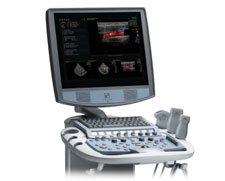
The Zonare ultrasound system is a fully-fledged ultrasound machine packed into a compact portable ‘scan engine’. The machine differs from conventional portable machines and larger cart based systems in many ways.
First of all do not be fooled by its diminutive size. The technology involved (more later) means that this machine is fully capable of high resolution B mode scanning with the addition of compound imaging and tissue harmonics. It is also capable of spectral Doppler, colour Doppler and power Doppler.
We managed to borrow a machine for two weeks and put it through its paces. We were looking for a machine with all the features of our standard departmental ultrasound machines (Philips IU22), but that could be easily used in the interventional room and operating theatres for interventional procedures such as nephrostomy, PCNL, RF ablation, PTC and intraoperative tumour localisation. We also needed a machine with sensitive colour Doppler for post organ transplant vascular assessments. Our current problem is that the machine we use in intervention is large, poorly manoeuvrable and of limited ability. Needles are difficult to see, tissue contrast is poor and RF generators interfere with the image. We also need a machine that can easily be moved up one floor to the operating theatres at short notice without going in the lift!
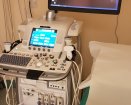
The Zonare Z.one is essentially the portable ‘scan engine’. This can be mounted on the cart to give a larger screen, keyboard, easier access to controls, somewhere to put the probes and jelly. The scan engine can be operated to full capability when detached from the cart and easily carried in one hand.
This is a little difficult to explain and to be honest I only understand the basics of how it works. The Zonare machine uses a fundamentally different mechanism of data acquisition and image formation to other ultrasound machines. Data is acquired in ‘zones’. Each new zone that is acquired has data that overlaps with the previous zone. This data is held in Channel domain memory. Areas of the image with a low signal to noise ratio have a larger amount of overlap with data from other zones leading to uniformity of signal detection. Zone sonography treats all of the received echoes as useful information. This is done by analysing returning echoes from each pixel and adjusting them to compensate for the variation in intensity of the transmit wave. This creates an effective focus at every pixel in the image. This explains why there is no focus control on the Zonare machine as all pixels are ‘focussed’.
The other advantage of zone sonography is the short sequence of acquisition events to produce an image frame. This allows plenty of ‘free time’ in the acquisition cycle to acquire other modes without reducing the B mode quality.
Zonare claim that their technology moves ultrasound from a speed of sound constrained environment to a computational speed environment. Thus with Moore’s Law stating that computational power will roughly double every eighteen months (and it still is) there will be continual improvements in this machine’s speed and capability.
Our machine had clearly been around quite a few hospitals but seemed to be standing up well. The only minor problem we had was it required a reasonable amount of force to re engage the scan engine with the cart after portable use.
The cart itself is sturdy but light and easily manoeuvred. There are plenty of slots for the many available probes. The screen is a large LCD that can be swivelled in any direction. The scan engine is easily released by a catch just anterior to it. A useful feature is that it can be released and attached whilst turned on. Probes are attached on the right of the scan engine and again can be ‘hot swapped’ which does save time.
The scan engine is sturdy but easy to carry in one hand. Its best placed on a trolley or stool for portable scanning as it is quite heavy if using for a prolonged time.
Probes
C5-2 curved array, abdominal, obstetrics, intervention. (2 harmonic frequencies)
E9-4 endovaginal probe, obstetrics, (1 harmonic frequency)
L10-5 linear array, small parts, peripheral vascular, (1 harmonic frequency)
L8-3 linear array, peripheral vascular, small parts, transverse needle guide built in, (2 harmonic frequencies)
P10-4 phased array, neonates, paediatrics, (1 harmonic frequency)
Power up is quick. (I get very irritated by machines that seem to take forever to boot when you are desperate to get on with a complex case.) Patient demographics are entered in a standard way. Select the probe you need by simply plugging it in. Menu options are accessed by the ‘rocker pad’ on the left (see images). The keyboard is located below the display, which I initially found irritating (probably because the machine I am used to is the opposite). The keyboard is actually rarely used once you are scanning. There are also several ‘soft keys’ beneath the display whose function changes depending upon the selected mode.
The controls are fairly standard and easy to find your way around. It’s initially a little disconcerting to have no focal zone adjustment. There is a very useful ‘optimize’ button that ‘does what it says’ to the image, adjusting several parameters without having to enter any menus.
The monitor is a flat panel LCD (1280x1024) mounted on a movable arm. The actual image takes up less than 1/3 of the display but I understand this will be user configurable in the near future. The remainder of the display contains patient demographics, drive capacity, recent measurements and your last three stored images.
Images are stored onto hard disc but can also be stored on USB flash memory if needed. PACS linkage is standard. Images can also be exported onto USB flash memory for importing into teaching collections and PowerPoint. One thing to note is that they do not get a file extension. The still images are .TIF format and the videos are QuickTime .MOV files. These file extensions need to be added manually once copied onto your computer.
The scan engine is easily removed from the cart. All the same functions can be accessed via the menu system. The screen is fairly small but is of very good resolution and we did not find that this compromised scanning.
We have taken a variety of images of some of our cases over the two weeks we had the machine (see images) Some are shown with comparable images of the same patient scanned with a Philips IU22 machine which is our current ‘gold standard’.
Grey scale imaging was superb with excellent tissue differentiation. Compound imaging appeared to give a slightly over smoothed image with some probes and I mostly used it turned off. Others who used the machine disagreed with me on this and preferred the compound imaging. Tissue harmonics were good and I found them especially helpful with larger patients and renal work.
The machine showed very good Doppler sensitivity. One of my colleagues managed to demonstrate a type 3 endoleak with this machine that he had previously only been able to see with the IU 22.
The 10/4 sector probe has a very small footprint useful for paediatrics and some interventional work (see images). The 10/4 linear was excellent for vascular and ‘small parts’ such as thyroid and testes. We found the 5/2 MHz curvilinear probe best for general work and abdominal intervention.
I performed 2 renal RF ablations and a colleague performed a liver RF ablation using the Zonare for guidance. In all cases the needle was very easy to see compared with our standard interventional machine and there was no interference from the RF generator.
Unfortunately we did not manage to try out all the probes including the hockey stick and endocavity probes
When I first saw this machine I was a little sceptical that it was a fully capable scanner in such a small package. 2 weeks of use both within the ultrasound department, in theatres, in the IR room and on the wards have proven that it is. The comparison pictures we have taken also add credence to this. I am not aware of another machine on the market that can be both cart based and portable yet offer these features.
Dr Philip J Haslam
Consultant Interventional and Uroradiologist
No conflict declared.