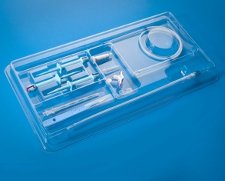
Chest drainage catheter introduced using Seldinger Technique. The Seldinger Chest Drainage Kit has been specifically designed to combine the benefits of the Seldinger approach with the advantages of small catheters, allowing the easy insertion of a small chest drain into the pleural cavity...
read full descriptionPlease either Login or Register for an account
(From Rocket Medical)
Chest drainage catheter introduced using Seldinger Technique. The Seldinger Chest Drainage Kit has been specifically designed to combine the benefits of the Seldinger approach with the advantages of small catheters, allowing the easy insertion of a small chest drain into the pleural cavity for the management of non life-threatening pleural problems such as pneumothorax, low protein content effusions and low viscosity empyema.
Review by Dr Ian Nesbitt, Consultant Anaesthetist
Freeman Hospital, Newcastle upon Tyne, UK
The author has no financial or other pecuniary interest in the device or device manufacturer reviewed.
Many patients in General Intensive Care Units have transudate pleural effusions rather than exudative effusions or haemothoraces. The clinical effectiveness of draining these effusions is variable, but increasingly used in ICU to aid in weaning from mechanical ventilation.
The standard equipment we use is the Rocket Chest Drain kit.
This is a 12French gauge drain, inserted with a typical Seldinger dilational technique.
The original dilator has a sliding safety stop to prevent over-insertion. The latest version of the kit includes a clip on plastic guard to prevent insertion deeper than 5cm.
There is a choice of connector to the drainage tubing & underwater seal (supplied separately), and a three way tap to facilitate sampling and flushing if required.
Overall, this is a great bit of kit, with numerous advantages (for patients and clinicians) over the traditional dissection drain insertion. It is faster, less invasive, less painful, and as effective in draining air and transudate compared to traditional ICD insertion. This is especially the case for smaller patients with narrow intercostal spaces. Additionally, removal is quicker and easier (particularly with regard to dressings) than larger open ICDs.
However, there are a couple of caveats. I always use real time ultrasound guidance to place these drains. Partly this is due to the patient population (critically ill), who often have abnormalities of diaphragm position, or consolidated lung segments etc. Partly this is due to the ease of puncturing unintended structures if carrying out drain insertion blindly.

The second caveat is that there is a definite learning curve associated with using these drains. Many novices seem to struggle with maintaining the correct alignment of guide wire, dilator and drain as each is inserted and removed. This can result in guide wire kinking. This kinking may either be unnoticed until the end of the procedure (when the guide wire can only be removed by withdrawing the whole drain and starting again), or is discovered when dilation of the track is difficult.
Awareness of this possibility, along with rotation of the dilator and drain during insertion may help reduce this frustrating complication. The company provide a video of drain insertion for information.
Stitch fixation of the drain is simple, although a variety of fixing devices are available.
These may be more useful in ambulatory patients, but should not usually be required for bed bound patients.
Learning curve. Requirement for complete second kit if guidewire kinks significantly.
Ian Nesbitt qualified from Newcastle upon Tyne Medical School, trained in the UK, Australia and New Zealand. He works as a consultant in the NHS in Anaesthesia & Critical Care.